Codec Avatars
I brought character craft into a research environment, helping turn subtle questions of likeness, expression, and presence into concrete visual judgments the wider team could test.
Likeness · Expression · Presence
- Research context
- Photoreal digital doubles for realtime VR interaction.
- My contribution
- Character craft, technical implementation, visual evaluation, and experience-building.
- Core question
- Does the driven avatar still feel like the person?
How I worked with the research team
My role sat between what the system could produce and what a person could recognize as themselves.
One collaborative loop, in order: the research team develops the avatar system; the system produces a driven digital double; I evaluate likeness, expression, and presence; specific visual feedback and authored targets go to the wider team, which tests and iterates on the system.
- Research team develops the avatar system
- System produces a driven digital double
- I evaluate likeness, expression, and presenceMy contribution
- Specific visual feedback and authored targets
- The wider team tests and iterates
Wider project context
- I joined the Pittsburgh research lab in 2015 as a Character Artist.
- The photoreal avatar work was shaped by capture, reconstruction, tracking, and machine-learning research.
- I brought a game-character creation perspective and needed to understand what each part of the system could produce.
- My title stayed Character Artist while the work expanded across character creation, visual evaluation, authored targets, and realtime experience setup.
A smile is not one shape
A driven avatar could produce a recognizable smile and still miss the particular way that person smiled.
Two paths compared. Tracked performance plus available expression shapes produce a technically recognizable smile. Person-specific asymmetry plus distinct facial activation produce a smile that feels like this person.
Tracked performance
Available expression shapes
Technically recognizable smile
Person-specific asymmetry
Distinct facial activation
A smile that feels like this person
Technical accuracy did not always produce personal likeness. I evaluated where an expression diverged from the person and translated that perception into specific visual feedback the wider team could test.
Why expression fidelity required visual judgment
- People often recognized that an avatar felt wrong without being able to say why.
- A person’s smile might be slightly asymmetric or activate different areas of the face in a distinctive way.
- The available shapes, and the transitions between them, did not always preserve those individual qualities.
- I compared the driven avatar with the person, identified the visual discrepancy, and evaluated whether the expression still felt authentic to them.
- My role was not to develop the underlying research system. It was to make subtle perceptual differences concrete enough to support further testing and iteration.
Presence had to be evaluated in context
I built 3D environments in Unreal Engine and set them up in VR so the wider team could evaluate how avatars felt during realtime interaction.
Avatar fidelity, expression and motion, environment and lighting, distance and scale, and realtime interaction combine into perceived presence. The factors act together; they are not sequential stages.
- Avatar fidelity
- Expression and motion
- Environment and lighting
- Distance and scale
- Realtime interaction
Perceived presence
- Interaction
- Creating spaces for one-to-one conversation at a comfortable distance.
- Environment
- Dressing the space and configuring lighting around what the team needed to evaluate.
- Scale
- Using real-world proportions so miniature and nonhuman avatars felt correctly situated in VR.
Why the environment changed the evaluation
- An avatar could not be evaluated only as an isolated character or technical output.
- I built and dressed 3D environments in Unreal Engine, then set them up for evaluation in VR.
- The spaces supported close, one-to-one interaction and helped the wider team judge whether the experience felt comfortable and natural.
- Lighting was configured as part of each environment according to what needed to be evaluated.
- For a miniature creature meant to sit on a desk, real-world scale made the spatial relationship feel credible rather than like a reduced full-sized model.
Related exploration within the wider Codec work
Exploring expression beyond realism
The core Codec work focused on photoreal digital doubles. A related exploration considered how human expression might translate to stylized and nonhuman avatars.
A humanoid form pushed toward stylization
- Developed from an initial sketch by the art director.
- Designed in collaboration with the art director and research team.
- Sculpted and modeled the final character.
- Created the expression and speech targets.
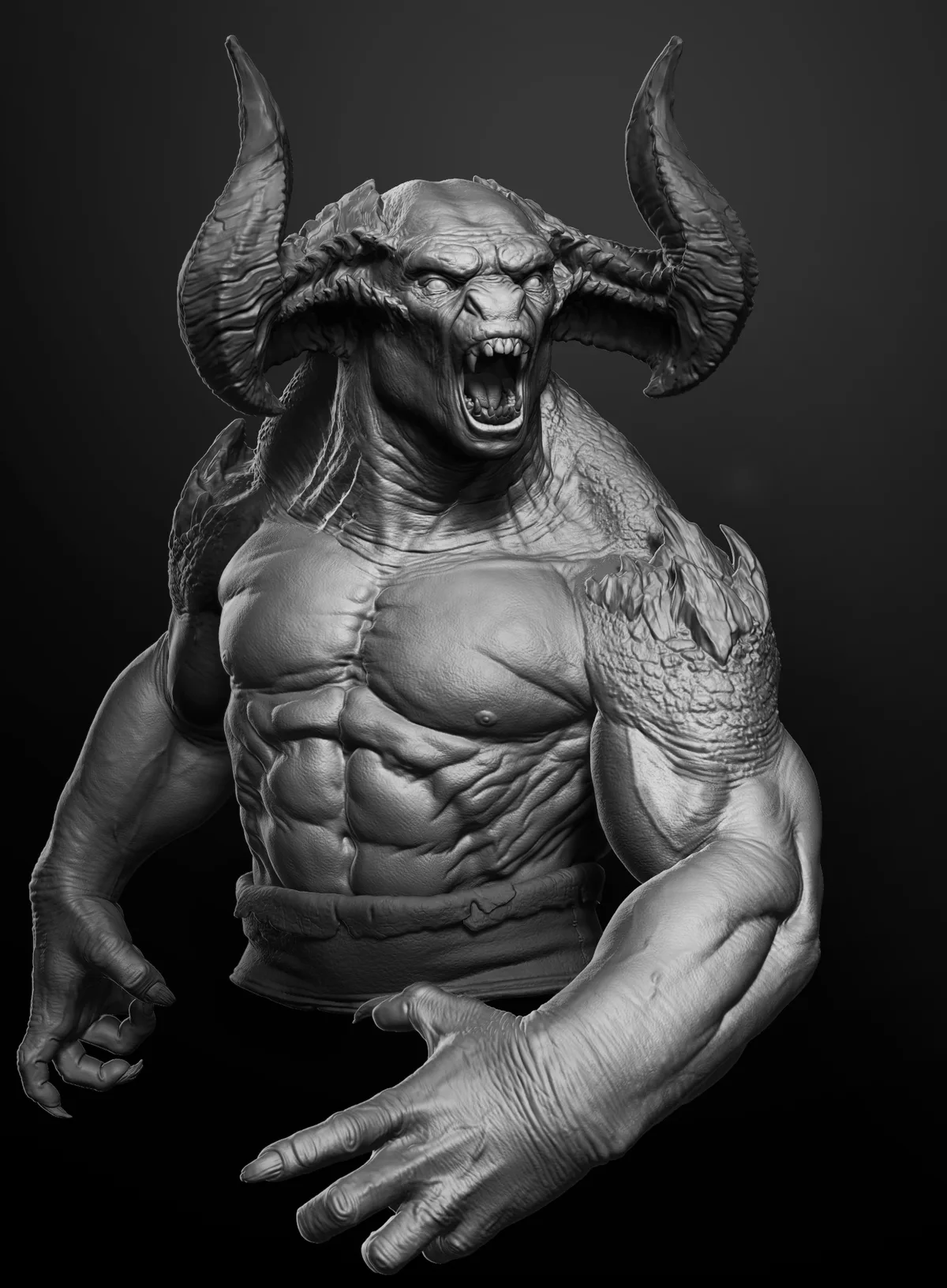
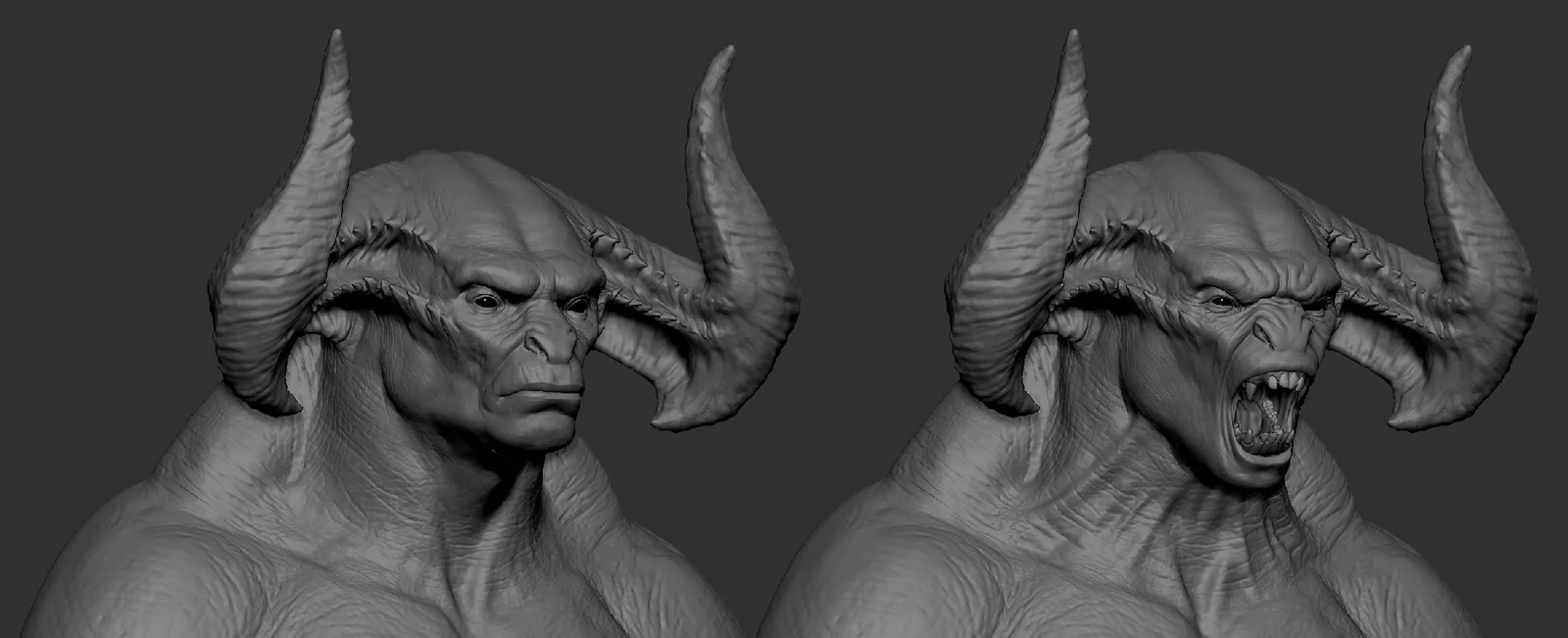
These studies reached the authored-shape stage. The horned character shown here was not rigged or driven through realtime facial tracking.
Designing expression for a nonhuman face
- Expression targets inspired by exaggerated, cartoon-like expressions.
- Speech shapes designed around a face that did not follow ordinary human anatomy.
- Expressive range authored as part of the character rather than captured from a real face.


How this related to the wider Codec work
- The primary Codec effort investigated photoreal digital doubles driven in realtime.
- As the capture system matured and avatar generation moved closer to automation, the art and technical-art team explored a stylized direction alongside the research team.
- A stylized character had no real-world face waiting to be captured, so its expression space had to be designed.
- The wider team considered whether authored shapes, animated examples, and more exaggerated targets could provide the expressive range a future system would need.
- My contribution was character development, the final sculpt and model, and the authored expression and speech targets.
What I carried forward
Working alongside research teams changed how I evaluated digital characters. I learned to look beyond whether an avatar appeared realistic and consider whether its expression, movement, and surrounding experience still felt connected to the person.
- Likeness is more than appearance
- Expression, movement, and context affect whether an avatar feels like the person.
- Technical accuracy is not always perceptual accuracy
- A result can function correctly while still feeling subtly wrong.
- Visual judgment can make subjective problems concrete
- Identifying a discrepancy gives the wider team something it can evaluate and refine.
From individual likeness to representation at scale
Working on Codec Avatars sharpened how I evaluate the relationship between a person and their digital representation. In Avatars 2.0, that sensitivity became part of a much larger product and production challenge.
Codec Avatars meant understanding one person closely, through likeness, expression, and presence. Avatars 2.0 meant building representation systems for many people, through visual direction, product decisions, and production systems.
Codec Avatars
Understanding one person closely
Likeness · Expression · Presence
Avatars 2.0
Building representation systems for many people
Visual direction · Product decisions · Production systems
Project context